C++ programming
 3 min read
From source to binary
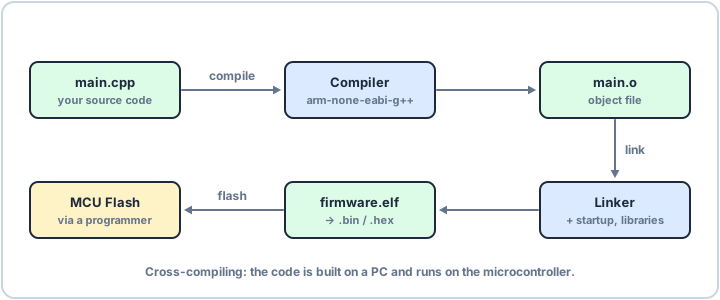
Your C++ file is just text. A compiler turns it into machine code for one particular processor, a linker joins the pieces into a single image, and a programmer copies that image into the microcontroller’s Flash. Execution then starts in main().
The smallest program
Every C++ program starts in main(). On a PC, main returns a status to the operating system when it finishes. On a microcontroller there is nothing to return to, so firmware’s main never ends (see Loops).
#include <iostream>int main() { std::cout << "Hello, embedded world!" << '\n'; return 0;}Hello, embedded world!
Compile, link, flash
The compiler checks your code and produces an object file for each source file. The linker combines those object files with startup code and libraries, and places code and data at the addresses in the chip’s memory map.
For a microcontroller you use a cross-compiler, such as arm-none-eabi-g++. It runs on your PC but produces code for an Arm Cortex-M. The result, an .elf converted to .bin or .hex, is written into Flash by a programmer or debug probe.