Topic
C Programming
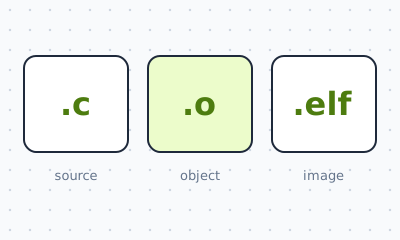
C is the most widely used language for firmware. Sixteen short insights build up the C you need, starting with the compiler chain, with what changes on a microcontroller (MCU) and on a microprocessor (MPU). Each one is a 3–4 minute read with a diagram, C11 code that compiles without warnings, and the output it prints.
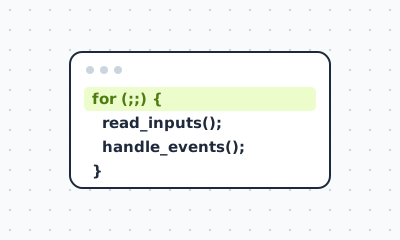
Read the first insightvoid poll_sensors(void);int main(void) { for (;;) { poll_sensors(); }}Insights
-
-
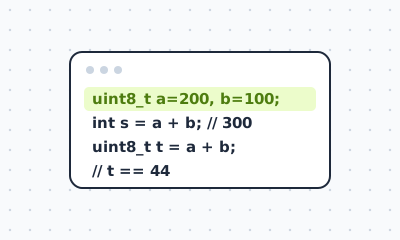
Types and integer widths
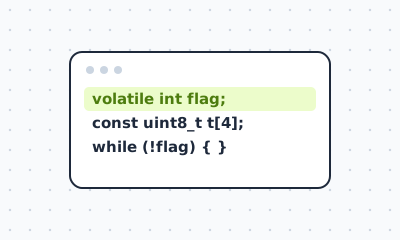
int, stdint, sizeof, promotion and overflow: how wide is a number?
 4 min read
-
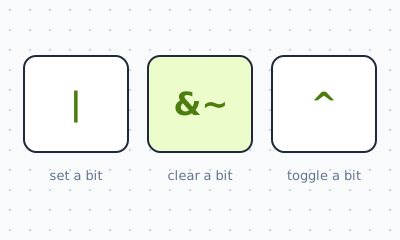
Operators and bit operations
Logical vs bitwise, shifts and masks: set, clear, toggle, test.
4 min read -
-
-
-
-
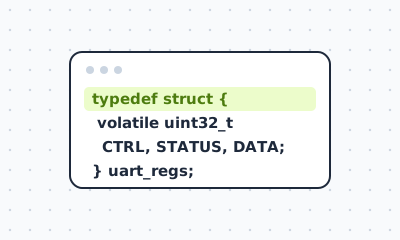
Structs, unions and bit-fields
Layout and padding, unions, bit-fields and register overlays.
3 min read -
-
-
-
-
-
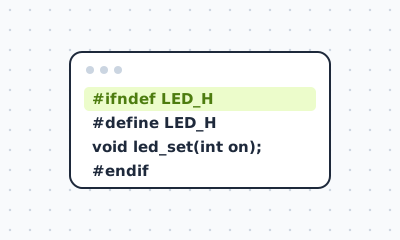
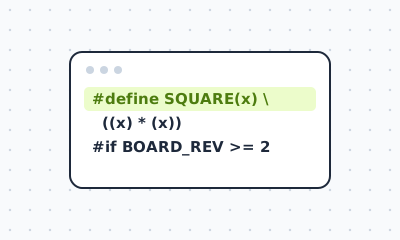
Headers and multi-file projects
Declaration vs definition, include guards and private names.
3 min read -
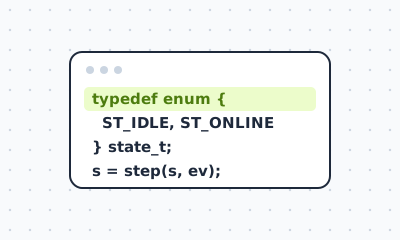
enum, typedef and state machines
Named states, switch-based and table-driven state machines.
3 min read -
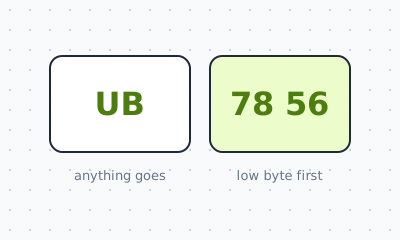
Undefined behaviour and endianness
UB traps the optimiser exploits, and byte order on the wire.
3 min read