C++ programming
 2 min read
public, private, protected
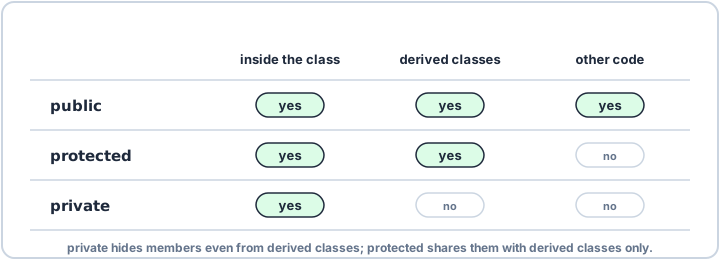
Access specifiers decide who may touch a member. Keep data private and expose a small public interface, so the rest of the firmware can’t put the hardware into an invalid state.
A safe interface
Here the duty cycle can only change through set_duty(), which keeps it between 0 and 100. Code outside the class can’t write duty_ directly.
pwm.cppC++
#include <iostream>class PwmChannel {public: void set_duty(int percent) { if (percent < 0) percent = 0; if (percent > 100) percent = 100; duty_ = percent; } int duty() const { return duty_; }private: int duty_ = 0; // only PwmChannel may write this};int main() { PwmChannel fan; fan.set_duty(140); // clamped to 100 // fan.duty_ = 140; // error: 'duty_' is private std::cout << "duty: " << fan.duty() << "%\n";}Output
duty: 100%
protected
protected sits in between: derived classes can use the member, other code can’t. It is useful in a base class that its subclasses build on, as in the next insight.