C++ programming
 3 min read
Classes and objects
A class bundles data with the functions that use it, and each object is one instance with its own data. A constructor sets an object up the moment it is created, which in firmware can mean configuring a pin.
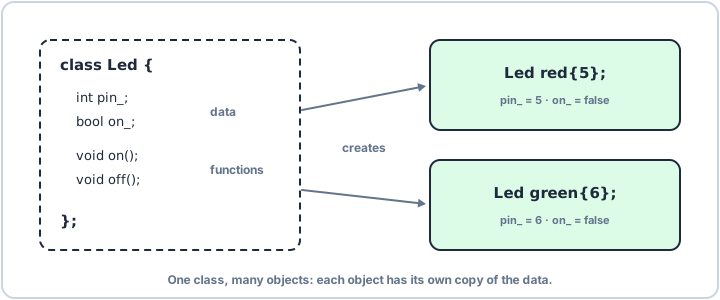
Data and functions together
led.cppC++
#include <iostream>class Led {public: explicit Led(int pin) : pin_(pin) { std::cout << "pin " << pin_ << " configured as output\n"; } void on() { on_ = true; std::cout << "pin " << pin_ << " on\n"; } bool is_on() const { return on_; }private: int pin_; bool on_ = false;};int main() { Led red{5}; Led green{6}; red.on(); std::cout << "green is " << (green.is_on() ? "on" : "off") << '\n';}Output
pin 5 configured as output
pin 6 configured as output
pin 5 on
green is off
Constructors set things up
The constructor runs as soon as the object exists, so a pin is never left half-configured. The : pin_(pin) part, the member initializer list, sets members before the body runs. Pair setup in the constructor with clean-up in a destructor, ~Led(), and you get RAII: resources are tied to the object’s lifetime.