C++ programming
 3 min read
Pointers and references
A pointer stores an address, and * reads or writes what it points to. In firmware, a pointer to a fixed address is how C++ talks to hardware registers.
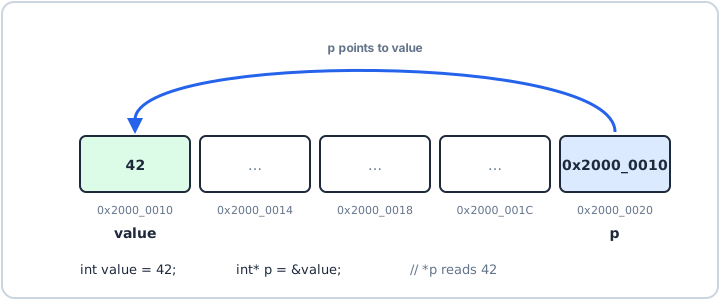
Addresses and values
&value takes the address of a variable, and *p follows a pointer to the value. A reference is a second name for an existing variable.
pointer.cppC++
#include <iostream>int main() { int value = 42; int* p = &value; // p holds the address of value *p = 7; // write through the pointer int& r = value; // r is another name for value r += 1; std::cout << "value=" << value << " *p=" << *p << '\n';}Output
value=8 *p=8
Pointers to hardware
Registers live at fixed addresses in the memory map. A volatile pointer makes sure every read and write really happens, because the hardware can change the value on its own.
gpio.cppC++
#include <cstdint>// STM32F103: GPIOA output data register (ODR) at 0x4001'080C.volatile std::uint32_t* const GPIOA_ODR = reinterpret_cast<volatile std::uint32_t*>(0x4001'080C);void led_on() { *GPIOA_ODR |= (1u << 5); // drive PA5 high}